A Diwali book for kids, with your child at the heart of the lights
Diyas, rangoli and sweets, and your child in the middle of it all, with a grown-up’s steady hands on every flame.
In 2026 most calendars put Diwali on Sunday 8 November, with Dhanteras on 6 November. The date moves each year with the lunar calendar, so check your own.
See where the story is heading before you confirm.
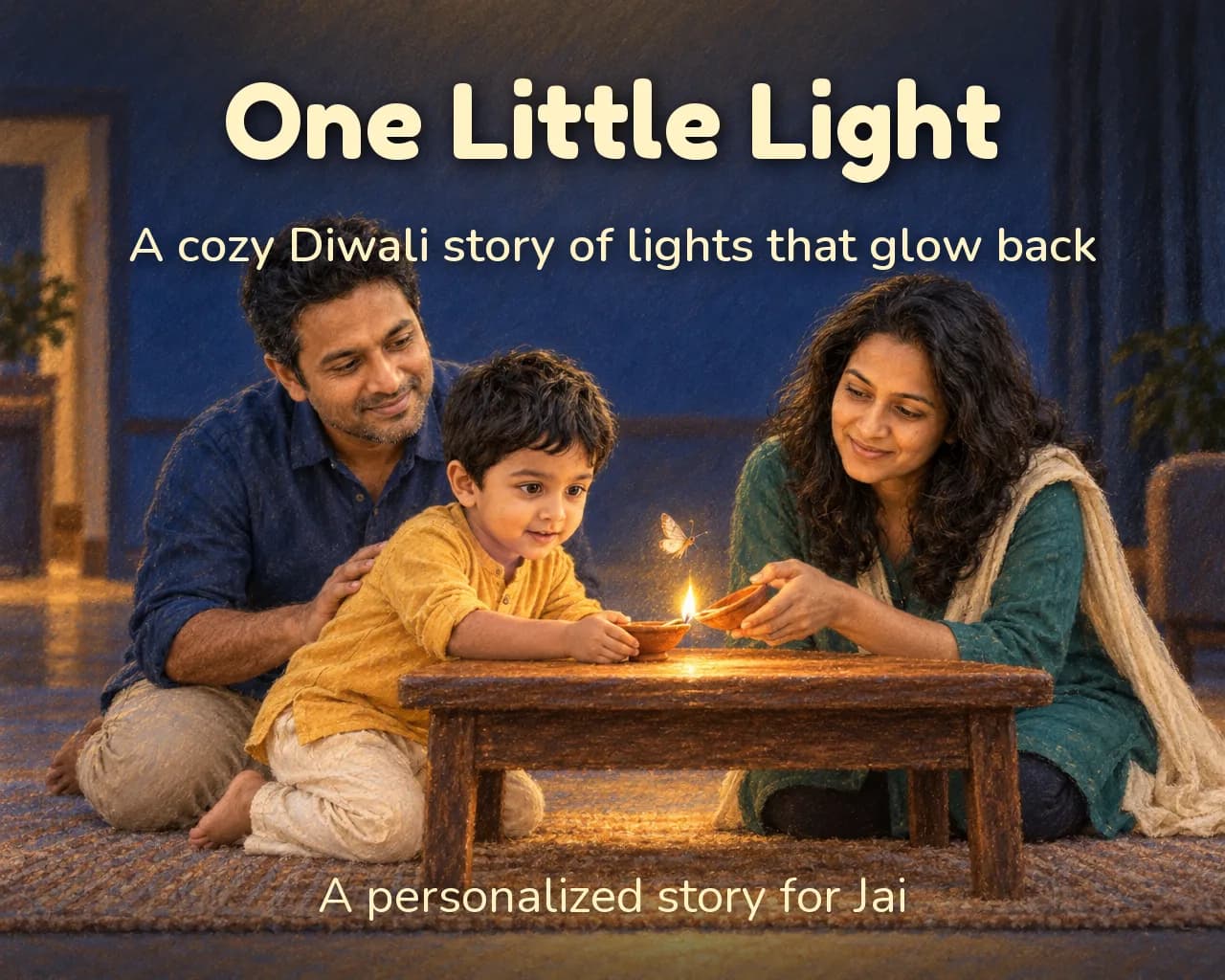
Look inside
A real book, made for Jai
Jai was 3. These are pages from One Little Light, in Pastel Portrait.
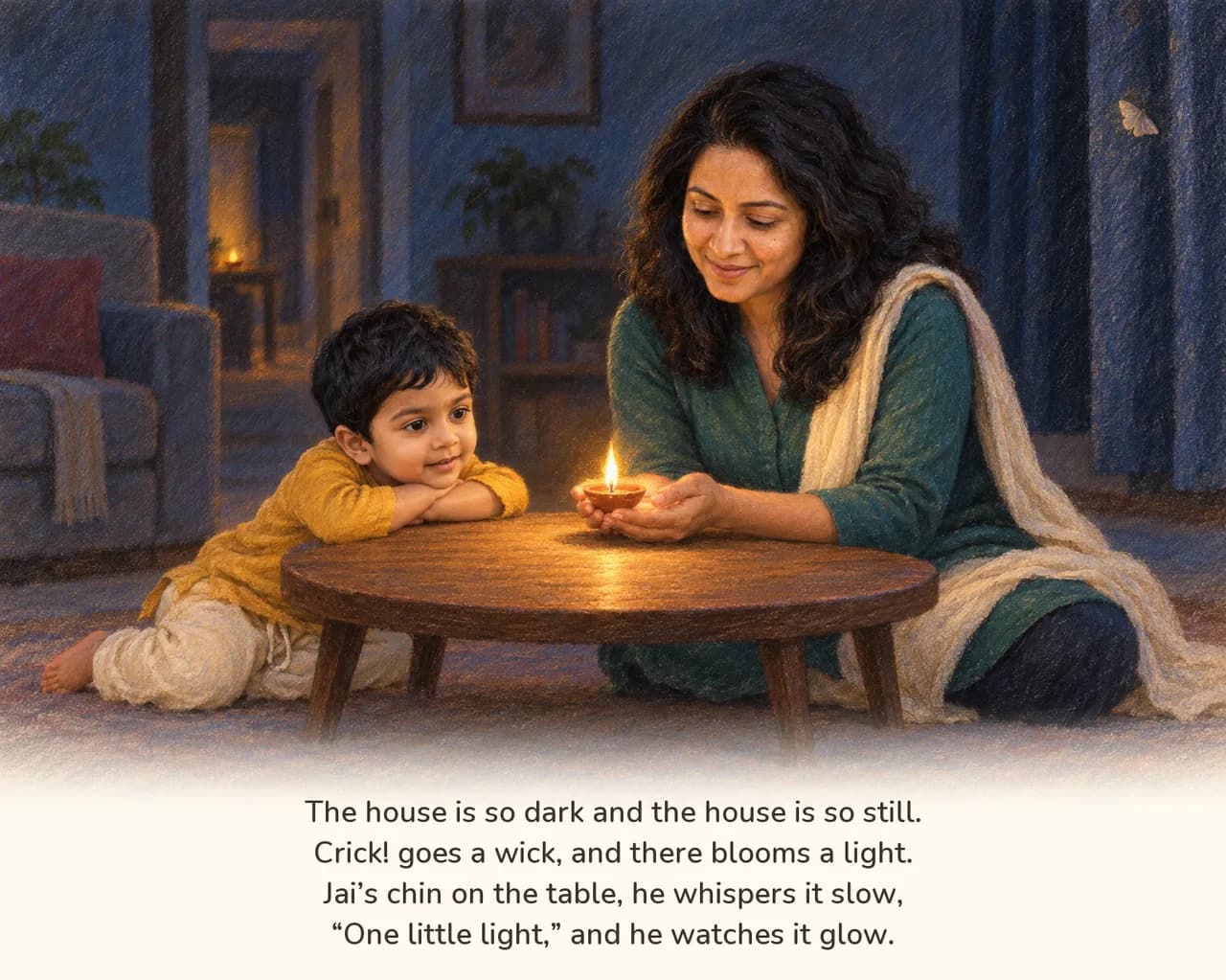
Page 1 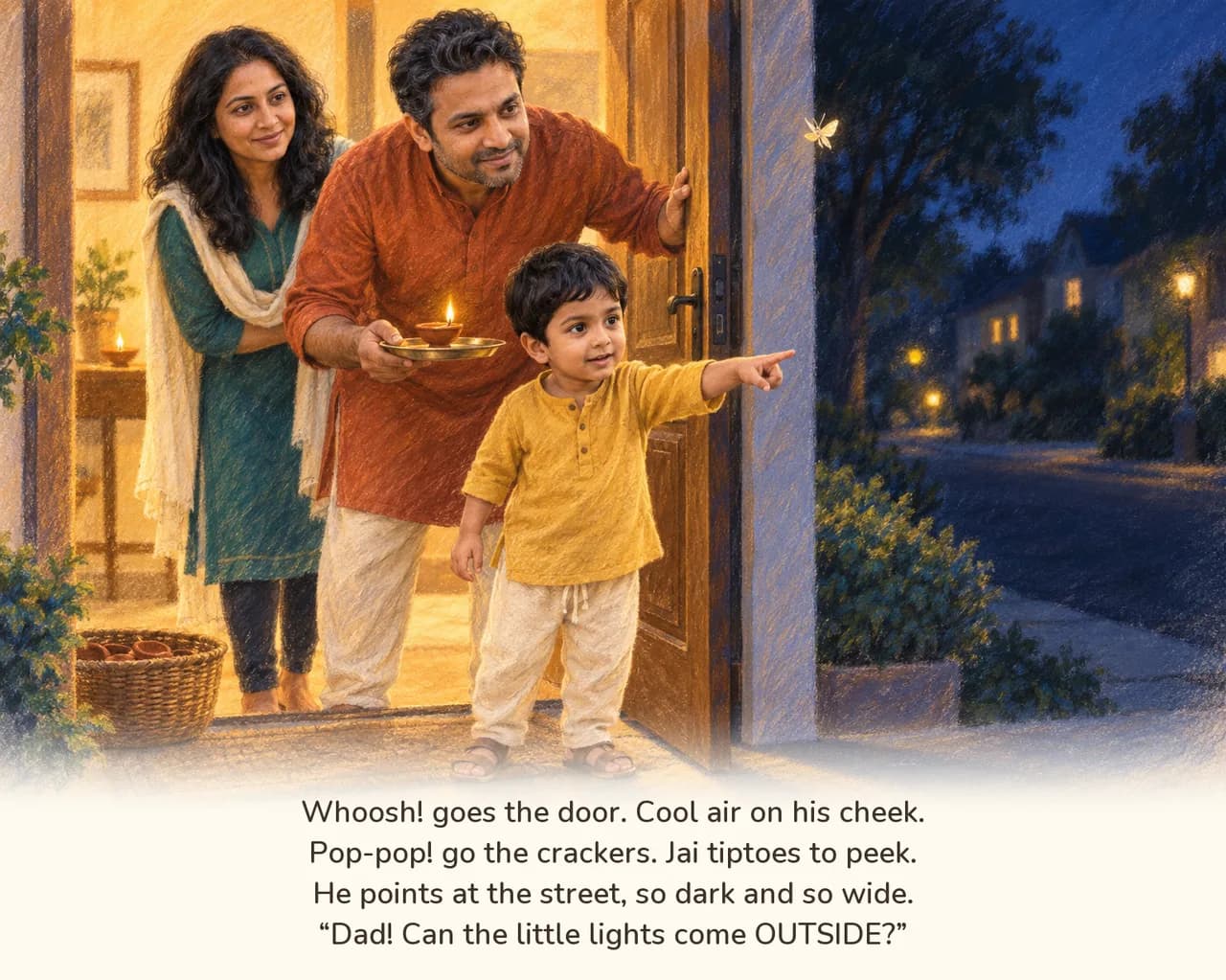
Page 5 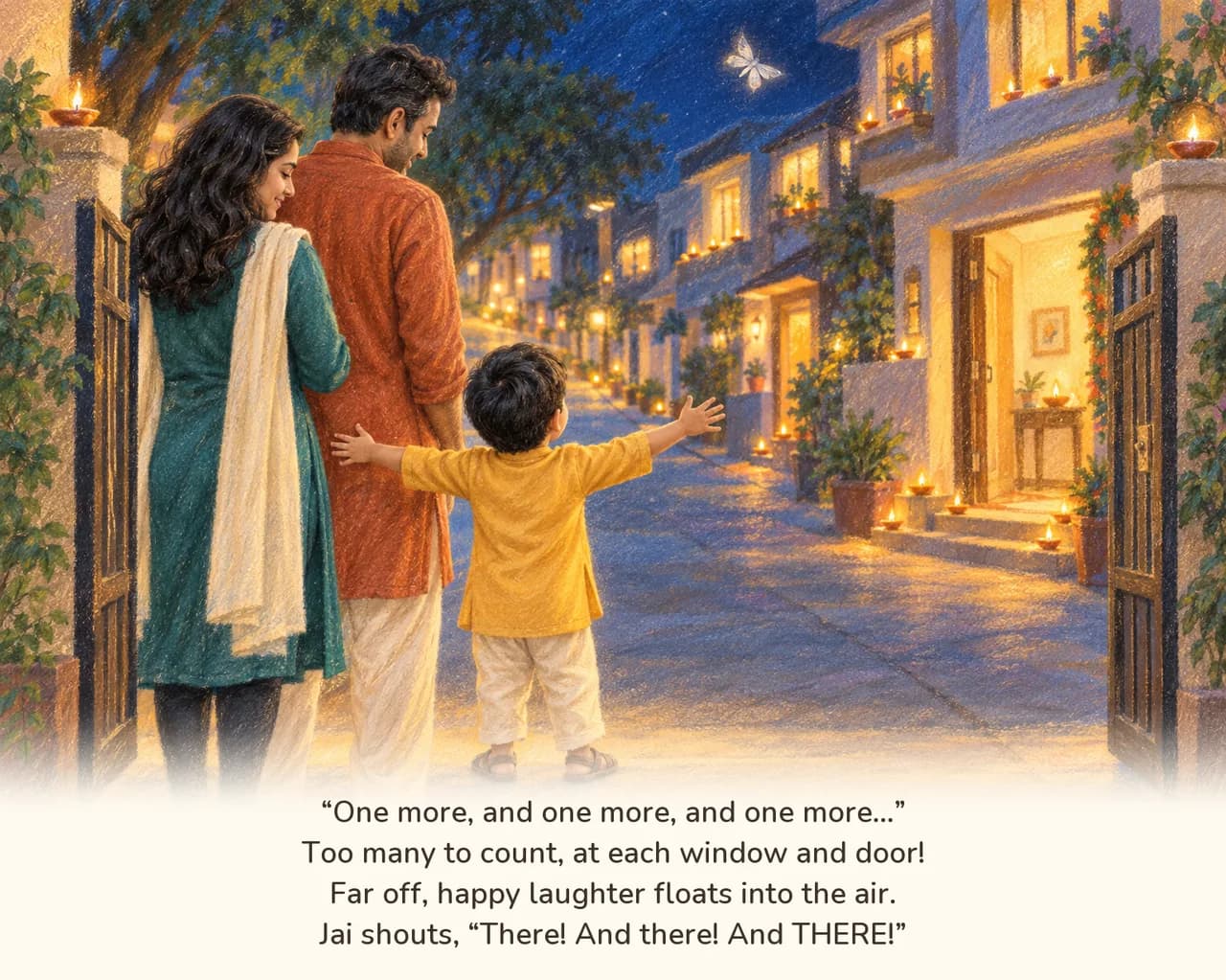
Page 9
The house is so dark and the house is so still. Crick! goes a wick, and there blooms a light. Jai’s chin on the table, he whispers it slow, “One little light,” and he watches it glow.
Why this story
What it does for them
Diwali is a festival a young child can feel with every sense: the flicker of diyas along the windowsill, rangoli powder on their fingers, the sweetness of a ladoo. The story puts your child right in the middle: filling the rangoli, carrying the sweets, keeping a small light company, while a grown-up lights and steadies every flame.
Underneath the sparkle is a big idea told at a child’s size: light wins over darkness, and even the smallest diya pushes some of the dark away. For older children, the book can show a grandparent telling the story your family tells, and what it means to carry a tradition forward.
Diwali is about sharing too: plates of mithai for the neighbours, doors open, friends welcome. Whether your family celebrates in Delhi, Melbourne, Toronto or Auckland, or your child is joining a best friend’s family this year, the story starts from how you do it. Keep it, and it becomes part of your family’s Diwali for years to come.
By age
How the story changes with age
Ages 2 and under
Lights, colours and sweet things to taste: a short, glowing book full of sparkle words and the warm hush of lamps being lit.
Ages 3–5
Rangoli to fill, sweets to carry to a friend or relative, a small diya to keep company, and a space in the pattern saved for a visitor.
Ages 6+
A grandparent telling the story your family tells at Diwali, the one question it never answers, and your child’s part in carrying the tradition forward.
Make it yours
The same moment, a hundred different stories
A few ways it could go. Yours starts with one sentence about your child.
- Aanya helps Nani shape ladoos, and eats more than she makes.
- Finn helps with the rangoli for the first time at his best friend Arjun’s house.
- Dadi’s rangoli pattern, passed to Priya one swirl at a time.
- Diwali in a new city, with the first lamps lit on a tiny apartment balcony.
- Ivy’s class learns about Diwali, and she brings home a diya she painted herself.
Not quite this moment?Write your own. A book for any moment, big or small, in a sentence.
Write your ownYours to choose
What you can personalise
Their photo
One clear photo. We draw your child as an illustrated character who looks like them on every page.
Up to 3 people they love
A parent, grandparent, sibling or friend, from a photo or a few words of description.
6 art styles
From glowing watercolour to bold gouache and handmade paper worlds.
A dedication
Your own message at the start of the book, such as “Shubh Deepavali to our little light.”
Read-aloud
Every paid book comes with a narrated version to play at bedtime.
See where the story is heading before you confirm.
Before you start
Questions parents ask
Can it show how our family celebrates?
Yes. Put what matters in your sentence (the puja, the rangoli, who comes over, the sweets you always make) and the story is built around it. Families celebrate Diwali in many ways, and the book doesn’t assume one.
Can grandparents and cousins be in it?
Add up to 3 people with a photo or a description, using the names your child calls them. Everyone else can appear in the background of the celebration.
We celebrate Diwali outside India. Does the story fit?
Yes. Set it wherever you are: a flat in Toronto, a backyard in Perth, a street in Auckland. Printed books ship to Australia, New Zealand, the US, Canada and India.
When is Diwali, and when should we order?
Diwali falls in October or November, on a date that moves each year with the lunar calendar. In 2026 most calendars put the main day, with Lakshmi Puja, on Sunday 8 November. Start a little before you need the book: the finished pages are made once you confirm, and a printed copy also needs time for printing and shipping.
Does it work for a child joining a friend’s celebration?
Yes. A personalized Diwali book can tell the story of a child celebrating with a friend’s family or learning about the festival at school, told with care for the tradition.
Their moment, their story
Add a photo and check the idea. Before you confirm, you will see where the story is heading, and you can ask for up to three changes.
Start their Diwali bookDigital books from A$12.99, printed copies shipped to India, Australia, NZ, the US and Canada. See pricing