Getting a child to read isn't actually the hard part. The hard part is getting them to want to. A child who wants to read will practise. A child who doesn't will find a reason not to. The motivation problem is harder than the literacy problem — and it comes first.
Personalised children's books are often recommended as a tool for improving reading engagement. But not all personalised books are created equal, and “personalised” has become a marketing word that covers everything from a name swap to a fully illustrated character. Here's what the research actually says.
The reading engagement problem
Early reading motivation is one of the strongest predictors of long-term literacy outcomes. Children who enjoy reading in the early years practise more, build vocabulary faster, and enter school with a significant head start. The challenge isn't teaching the mechanics of reading — it's creating the conditions where a child chooses a book over everything else on offer.
Before children can read independently, the engagement has to come from being read to. A book that a child asks for at bedtime, that they want to hear again and again, is doing something right. The question is what.
What “reading engagement” actually means
Reading engagement is distinct from reading comprehension. Comprehension is what a child understands from a text. Engagement is whether they're paying attention, investing emotionally in the outcome, and willing to revisit the story.
Researchers measure engagement through behaviours: voluntary attention (the child is not distracted), willingness to reread (they ask for it again), emotional investment (they react to plot events), and retelling (they can and want to narrate the story back). These behaviours predict comprehension — engagement is the precursor.
The self-reference effect
The cognitive science behind personalised reading centres on a well-documented phenomenon called the self-reference effect. First documented by Rogers, Kuiper, and Kirker in 1977, and replicated consistently since, the core finding is this: information connected to the self is processed more deeply and remembered longer than neutral information.
When we encounter something that relates to us — our name, our face, our experiences — our brains prioritise it. We encode it more deeply. We recall it more readily. This isn't a quirk of personality or age; it's a feature of how human memory works.
In children, this effect is especially powerful because their sense of self is still forming. A story that places them at the centre doesn't just entertain — it shapes how they see themselves as a reader and as a character in the world.
What research says about personalised books specifically
Studies on personalised reading materials find consistently higher engagement when content is self-relevant. Children recall more detail, show more emotional investment, and request rereading more frequently. The effect is larger when personalisation is visual rather than purely textual.
Name-only personalised books — where a child's name replaces a generic name in a template story — show a modest engagement effect. The child hears their name and experiences a small boost of recognition. But the character doesn't look like them, and the story wasn't written for them.
Photo-based books, where an illustrated character modelled on the child's actual features appears throughout, show a stronger effect. Visual self-representation triggers a deeper identity connection than text alone. The research is clear on the direction, though worth noting that most studies in this specific area are small-scale; we treat it as evidence-informed rather than definitive.
Name-only vs photo-based personalisation — why it matters
A find-and-replace is not the same as a story designed around a child who looks like them. When a child opens a name-only personalised book, they hear their name attached to a character who could be anyone. The character has generic features, a generic story, and generic illustrations.
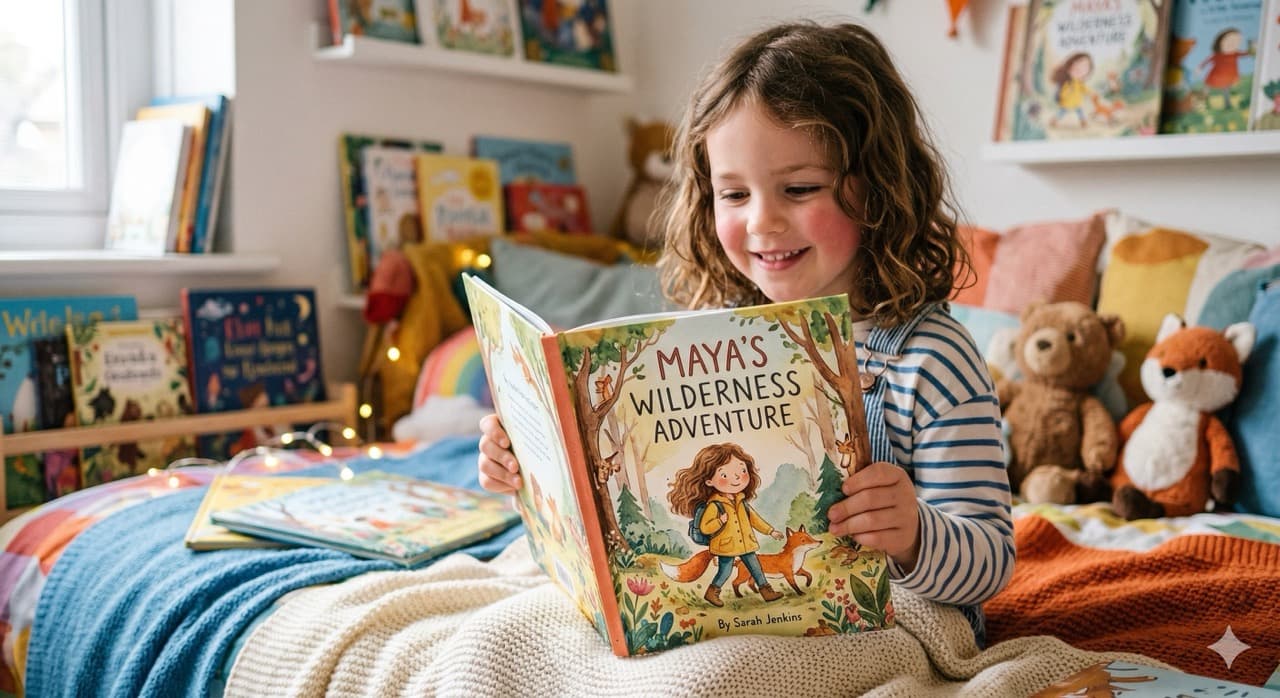
When a child opens a photo-based personalised book, they see themselves. Their hair, their face, their specific features — on every page, in different poses, in different scenes. The illustrated character creates an identity connection that the self-reference effect research predicts will produce deeper processing and stronger emotional engagement.
MakeMyStory uses photo-based illustration. When you upload a photo, the pipeline analyses your child's distinctive features and creates an illustrated character who appears consistently across all 12 pages. It's not a sticker on a generic illustration — it's a character built from the photo up.
What to look for in a personalised children's book
If you're evaluating a personalised book for a child, here are five practical questions worth asking:
- Does the child actually look like themselves? Not just a generic cartoon with their name — but a character with their recognisable features, present on every page.
- Is the story genuinely good? Not a template with blanks filled in, but a narrative with a beginning, middle, and end that was generated for this child's age and theme.
- Is the character consistent across all pages? Consistency matters for identity recognition. A character who changes appearance between pages breaks the connection.
- Is there a read-aloud or narration option? Essential for pre-readers. The engagement effect works even when the child can't read independently — but only if there's narration to carry the story.
- Can you review and refine before committing? A good personalised book service lets you see the story outline and request changes before the illustrations are generated.
A note on digital books and screen time
One concern we hear often: is a digital personalised book just more screen time? It's a fair question, and worth answering honestly.
Reading together on a screen is still reading together. The shared attention, the conversation about the story, the pointing and identifying — these are the things that produce reading engagement, not the physical medium. Research on shared reading consistently finds that the interaction between adult and child matters more than whether the book is paper or digital.
A digital book read passively in the background is screen time. A digital book read aloud together, with a child on your lap pointing at the illustrations and saying “that's me” — that's reading.
The goal isn't a child who can read. It's a child who wants to. Anything that creates that desire — that makes books feel personally meaningful before a child can decode a single word — is worth paying serious attention to.